Glass Skin vs Cloud Skin: Which Trend Is Taking Over in 2026
- Kajal Singh
- March 20, 2026
- Beauty
- Glass Skin vs Cloud Skin, slider
- 0 Comments
If you would have told me to 10 years ago that I will have an argument about skin looking shiny and smooth, as glass, or if it looks fluffy and soft, as being Cloud-like. I would have laughed at you. The goal at that time was matte finish, and powder was king, and shine would have been the last thing anyone wanted in their makeup.
Now a completely different world.
Before learning a new style it has already become outdated and a new style has started to develop itself.
Fast forward to 2026 and glow is no longer in discussion; we are now in the age of texture; we are now in the age of feel.
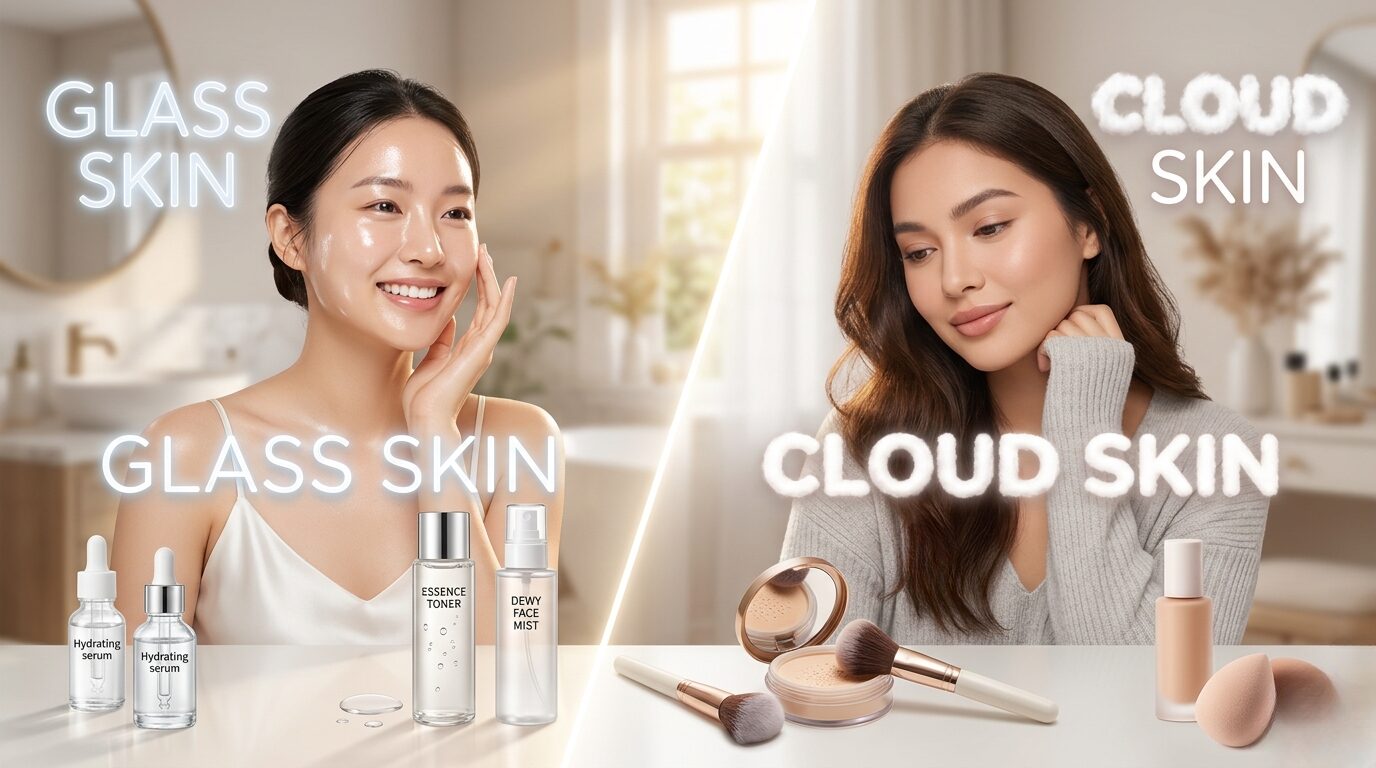
From one way to the opposite extreme, there is Glass Skin on one side and Cloud Skin on the other side. Glass Skin is defined as having the maximum hydration level by drinking at least 8 L of water daily, and utilizing a variety of different types of essences on your skin.
Cloud Skin is the newer of the two; Cloud Skin is defined as having a soft, filtered, and forgiving finish and feels like wrapping your face with velvet material.
The debate over the two types of skin has become the main topic of conversation in the beauty industry during this calendar year. It no longer matters which skin finish, glass skin or cloud skin, is “better”; what is important is determining which of the two finishes will work best for you at this time in your life.
Glass Skin: The Old Guard
Glass Skin originated from Korea and rapidly gained popularity around 2018. It is meant to be in opposition to a matte look, powders, and an overall flat appearance.
The look of glass skin is simple to describe but quite difficult to attain; glass skin is when your skin is smooth, hydrated, and plump enough to reflect light as if it were a polished surface – so much so that you can even see your reflection in the cheekbone of another person.
Achieving glass skin requires patience and dedication; at the absolute minimum, it requires seven steps: using a double cleanser, exfoliating, using a toner, an essence, a serum, a sheet mask, moisturizer, and facial oils followed by sunscreen. It is more than just a skincare routine, it is also a ritual; while some people love following these steps, others do not have ample time for such regimented skincare nor enough space on their shelves for all the products involved.
Finally, glass skin does not hide any imperfections; it emphasizes every pore and/or piece of peach fuzz; therefore, if your skin is not perfect in terms of being smooth, then the glass will show the blemished angle of your skin. While the overall effect is very pretty, it is also very demanding on perfection.
Cloud Skin: The New Standard
The cloud skin trend of 2026 did not happen by accident; it arose as a result of exhaustion from trying to appear put-together without spending 45 minutes layering multiple serums.
While glass skin is a reflection of light, Cloud Skin is the equivalent of putting on a cashmere sweater. It’s soft and pliable with a soft, dewy look but with a lot of texture and an appearance that’s okay to show off.
Cloud Skin reasons are based on using a range of products to create different effects than would typically be achieved with the use of highlighters and dewy foundations. Instead, blurring primers, soft matte foundation and light dispersing powders will be used to achieve the desired look. The overall goal will be to scatter, rather than reflect, the light with the use of such products. This scattering will aid in blurring out pores; minimization of fine lines; and achieving a velvety finish that photographically looks as good as it does close up.
The most interesting aspect of the new trend is the psychology behind it. Glass Skin represents an unattainable goal; “Look, I am perfect”. Cloud Skin represents acceptance of imperfection; “I am human and that is good”.
Head to Head
Let’s compare them directly.
Prep Work
Glass Skin demands hydration. You need humectants, ceramides, layers of moisture. If you skip a step, the shine turns patchy.
Cloud Skin demands a smooth base.
The Finish
Glass Skin is sharp. Light hits it and bounces back in a defined glare.
Cloud Skin is diffused. Light hits it and scatters. That scatter is what creates the “blur” effect.
Longevity
Glass Skin can slip. If you have oily skin, the gloss can turn greasy by midday.
Cloud Skin tends to stay put. Powder technology has come a long way. Modern blurring powders don’t cake. They just sit there, looking soft, all day.
Forgiveness
Glass Skin magnifies texture. If you have a breakout or dry patch, the gloss makes it more visible.
Cloud Skin minimizes texture. That blurring effect is forgiving. It’s why so many people are switching.
The Matte Myth
One thing I keep hearing is confusion around the Glass Skin vs matte skin trend conversation. People think Cloud Skin is just “matte” with a new name. It’s not.
The matte trend of the 2010s was about elimination. Eliminate all shine and all moisture and all signs of life. It resulted in flat, two-dimensional faces that looked great in flash photography but strange in natural light.
Cloud Skin is different. It’s matte in texture but not in dimension. Makeup artists in 2026 are using techniques like “backlighting”—placing highlighter under foundation—to keep dimension while maintaining a soft finish. Blushes are satin, not glitter. Lips are matte but not dry.
It’s the evolution of matte. It’s matte that breathes.
Which One Is Winning?
If you look at the data—what people are buying, what they’re wearing, what they’re searching for—Cloud Skin is currently ahead.
The Glass skin routine is expensive. It requires time, money, and commitment. Cloud Skin is faster. It works for more skin types. It works in more climates. It works for people who have ten minutes in the morning, not forty-five.
That doesn’t mean Glass Skin is dead. It’s not. It still dominates editorial shoots, red carpets, and the summer months when natural dew is easier to achieve. But for everyday life? For work, for errands, for dinner with friends? Cloud Skin is taking over.
How to Choose
Here’s what I tell people when they ask about Glass Skin vs Cloud Skin.
Consider your skin type.
If you’re dry, Glass Skin might feel more natural. The oils and creams that go into it will keep your skin comfortable.
If you’re oily, Cloud Skin is your friend. It controls shine while still looking like skin.
Consider your time.
Do you enjoy a long skincare routine? Do you find it meditative? Then Glass Skin is a perfect fit.
Do you want to look good in five minutes? Cloud Skin is faster and more forgiving.
Consider how you want to feel.
Glass Skin makes you feel sharp. Polished. Like you’re ready for a close-up.
Cloud Skin makes you feel cozy. Approachable. Like you’re comfortable in your own skin.
The 2026 Forecast
I’ve been watching beauty trends for over a decade. One thing I’ve learned is that trends rarely disappear. They evolve. They settle into different seasons, different moments, different moods.
Winter and spring: Cloud Skin will dominate. The soft, velvety texture matches the cozy vibe of sweaters and natural light.
Summer: Glass Skin will return. The heat makes skin naturally dewier, and the glossy look feels fresh and healthy.
Evening events: Glass Skin still wins for formal occasions. It catches candlelight and flash photography beautifully.
Everyday wear: Cloud Skin is becoming the default. It’s the “I look like I have a filter on in real life” look.
Final Thoughts
After ten years of writing about this stuff, I’ve stopped believing in “good” trends and “bad” trends. The only thing that matters is whether a trend works for you.
Cloud Skin is leading the way right now, thanks to its ease of use, but it also provides an opportunity for anyone to look great without spending a ton of time or money on their appearance!
If you enjoy the Glass Skin routine and find bliss in the process of glazing, and if you love how the light reflects off your cheek bones, then don’t allow anybody to pressure you into switching to the Cloud Skin trend. Glass Skin will always be beautiful and will always show that you have taken care of yourself and that you have healthy skin!
The important point from Glass Skin versus Cloud Skin, is that there is no need to choose a side for life! You can wear Glass Skin one day and Cloud Skin another day, Glass Skin in summer and Cloud Skin in winter, Glass Skin on date nights and Cloud Skin on Mondays!
And as for the Glass Skin vs matte skin trend? That debate is over. Matte, the flat, lifeless version is done. Cloud Skin is what matte always wanted to be: soft, dimensional, and human. Enjoyed the article, follow dturban for more fashion/lifestyle updates.