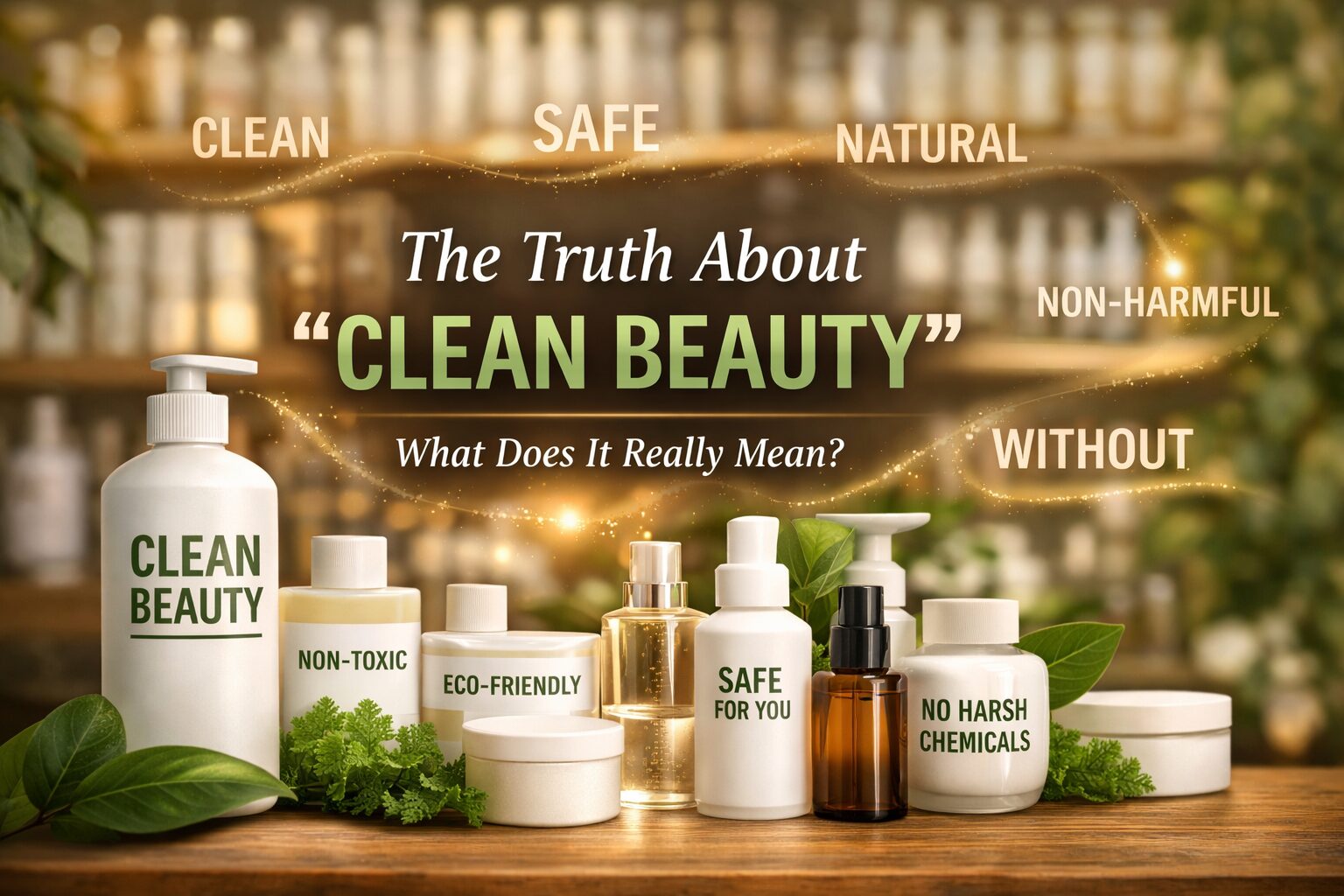
The Truth About “Clean Beauty”: What It Really Means for Your Skin
- Kajal Singh
- March 27, 2026
- Beauty
- clean beauty meaning
- 0 Comments
Safe comes to mind when hearing clean. Choosing it seems automatic. Step inside a shop selling skincare products now, one spot will show the term on bottles, “clean,” “not harmful,” “without,” “eco-friendly.” Words wrap around like a quiet promise. Comfort hides between those letters.
Here is a truth many overlook: what lies behind the phrase “clean beauty”? Few stop to wonder. It sits there, unexamined. Yet it shapes choices. Clean beauty Meaning shifts depending on who speaks. Some see purity. Others spot marketing. The label feels safe, until questioned. Who decides what counts as clean? Standards waver. Clarity slips away. That silence around definition, it matters.
Only when you pause long enough to notice does the truth show up, nothing like the clean version companies display.
What is Clean Beauty?
What does clean beauty meaning? It boils down to one thing, skincare made using only substances thought safe for people. Not filled with chemicals linked to health concerns. Instead, formulas skip those red-flag materials altogether. Some brands build around this idea completely. Others adjust slowly. Either way, the goal feels clear. Protecting skin matters more than trends.
Ah, that seems straightforward. Still, watch out, there’s a snag hidden underneath. A single clear meaning does not exist. Rules differ everywhere. Nobody sits at the top saying which products qualify as pure. A company may cut out two dozen substances. Another wipes away fifteen hundred. Each one claims the same label anyway.
That label says “clean,” yet it doesn’t mean rules back it. What stands behind the word is just how that company sees clean. Things begin to blur right about then.
The Rise of Clean Beauty and What Drove It
Fresh beauty trends weren’t born overnight. Rooted in worry, yes, but also questions bubbling up, fear played its part too.
Something shifted when folks began eyeing the stuff they rubbed on their bodies. Long strings of words on labels meant little, sounded strange, yet stayed stuck there. News flashes calling out specific substances only added fuel instead.
Folks just started searching for options that felt more straightforward. Safer, too. Trust came easier with those.
Brands responded.
“Free from parabens.”
“No sulfates.”
“Non-toxic formulas.”
What mattered shifted slowly away from ingredients inside toward those left out. Suddenly, tidying away makeup wasn’t just popular it meant something extra.
Clean Beauty vs Natural Skincare Differ
Here’s where things usually start to blur. Clean beauty cares about what won’t harm you, while natural skincare looks to plants first. They overlap here and there, still, their main concerns aren’t quite the same. A safety check drives one; origin matters more to the other.
Certain substances get left out when products aim for cleaner labels. Safety drives choices instead of trends. Some formulas skip what worries people even if rules allow it. Not every ingredient makes the cut just because it’s legal. Decisions come down to caution more than compliance. Folks often think nature means safe, yet that belief misses reality entirely. Take essential oils, straight from plants, sure, but they sometimes leave redness on delicate skin.
A single test tube creation might just sit right at ease inside your body. Stability often comes natural to those born in glass beakers. Effectiveness does not demand origin from soil or leaf. Safety shows up regularly in formulas mixed under bright ceiling lights.
Just because something is natural does not guarantee it is better. On the contrary, synthetic things are not always dangerous.
Most folks overlook how much that difference actually counts.
Commonly Skipped Ingredients in Clean Beauty
Spent any time checking out clean beauty red flags? Chances are, some ingredient names keep popping up. One thing leads to another, and suddenly those terms feel familiar, like they’ve been mentioned way too often to ignore.
Few clean beauty ingredients to avoid, when checked closely
Parabens
Crazy is how often people talk about these substances because they think the way cells chat gets changed or influenced by them, yet scientists keep debating without clear proof.
Sulfates
The white foam shows up when water touches the cleaner. Tight or red skin could mean a stronger reaction on somebody. A little burn can happen now and then.
Synthetic fragrances
Fragrances might carry secrets, what’s written doesn’t always tell the whole story. Smells can hide ingredients that never make it onto the bottle. Slippery details dodge detection easily. Pinpointing every part feels nearly impossible.
Formaldehyde-releasing preservatives
Once helped products last longer yet might cause irritation, especially when exposure increases beyond safe levels.
Here’s what matters most: being on this list doesn’t instantly make a substance risky, no matter how it’s used or how much there is.
What surrounds it shapes the outcome. The amount used changes everything. How it’s made plays a role.
Does Clean Beauty Help Skin?
This question might be on your mind, does clean beauty actually treat your skin more gently? Still, answers aren’t so clear, is clean beauty better for your skin?
Truth is, sometimes it just isn’t. Yet that doesn’t mean never. Some things hinge on how your skin reacts, what you’re dealing with, also the makeup of the item.
When it comes to clean beauty, advantages might show up under certain conditions
- You have sensitive or reactive skin
- You want to minimize exposure to certain ingredients
- You prefer simpler formulations
Yet that doesn’t mean it will definitely get better. Freshness fades quicker when certain clean items leave out tough preservatives. On the flip side, swapping lab-made components for plant-based versions sometimes stirs up more skin trouble than expected.
Fewer parts might make it work less well. Just because something is labeled clean doesn’t mean it wins by default. Sometimes simpler isn’t stronger.
The Marketing Face of Clean Beauty
Now comes the awkward part, still, it matters enough to mention. Clean beauty is also a marketing strategy.
Fear sneaks in when words such as “toxic” or “chemical-free” get tossed around, despite what research actually says. Water proves it – yes, even that’s a chemical. Made of elements, really, just like everything else we know.
Something odd happens when companies point out what they leave out, suddenly, other items feel risky, despite meeting every safety rule. Just because something claims to be clean doesn’t make it false, sometimes the real story hides behind pretty words. A label can sound honest without showing the full picture.
A feeling might carry the weight instead of proof. Truth isn’t always the loudest part of a moment. The heart leans where data doesn’t reach.
Why Chemical-Free Means Nothing
Fair point, straightening this out fast makes sense. Nothing is chemical-free.
Your skin, built from molecules. Around you, air flows, also chemistry in motion. What you drink, glass after glass, transforms into internal reactions. All things, without exception, trace back to chemical makeup.
Every time something claims to be “chemical-free,” that claim does not match science. Instead, it means the item lacks specific lab-made components
Finding your way through label wording gets easier when you see it clearly, steering clear of fuzzy promises just naturally follows.
Choosing What Fits You
One way to look at clean beauty isn’t about calling it right or wrong. Maybe a better path opens up when the question shifts slightly. What matters could lie in how we frame what we’re really after. Not labeling, but exploring. Could clarity come from focusing less on verdicts? The weight might rest in the curiosity behind the search itself, What does my skin actually need?
Few points worth remembering follow
Know your skin type
Skin acts up in many ways, dry one day, slick the next. Yet sensitivity might show when least expected. Each type follows its own rhythm, reacting without warning.
Read ingredient lists, not just labels
Just because it says “clean” up front does not mean much. Look behind to see what is inside.
Try a small spot first when using something fresh on your skin
A person might react, even if what’s inside seems pure. Ingredients that look safe on paper aren’t always gentle on skin.
Fear isn’t always needed around man-made stuff
Not every option holds up as well when compared to what comes from nature, some manage both strength and staying power far better.
Pay attention to how your skin feels
This means something deeper than a name could show.
The Balance Between Clean and Effective
A space exists between the noise, one rarely mentioned. Not loud, not hidden, just there, settled in silence others overlook.
Fine to leave some mess behind. It’s okay if you just leave it alone. Combining them works just fine. Fewer products can work better if used only on areas that need care. When dealing with issues such as breakouts or dark spots, pick ingredients backed by real studies. What matters is matching solutions to what your skin actually shows.
A routine might shift day to day. Flexibility fits better than rules. Truth is, that’s when folks usually figure out their groove.
Clean Beauty Meaning Ahead
Clean beauty sticks around, whether folks like it or not. Beyond standing still, change is shaping it. It moves, reshaped by what comes next.
Consumers are asking better questions now. Not just “Is this clean?” but “Is this effective?” “Is it safe?” “Is it backed by science?” That shift matters.
Beauty’s tomorrow? It hinges less on skipping substances, more on knowing what they do. Understanding beats avoidance every time. When you get there, the name on it begins to fade in importance.
Conclusion
What lies beneath clean beauty? Not a bad thought at all. Safer items, clearer labels, this kind of wish feels reasonable. Yet things rarely fit into just right or wrong. Whoever answers shapes what clean beauty means.
Few so-called toxic substances are dangerous under all conditions. If clean beauty suits you, that truth hides in your skin’s own nature.
Far from simple, the talk about clean beauty versus natural skincare holds layers most miss at first glance. Maybe aiming for what actually matters makes more sense than running after the idea of “clean.”.
What actually works for you. Your skin pays no mind to fancy names. What matters? The mix of what you put on it. Regular use counts too. Balance shifts results. Labels stay irrelevant. This reality turns out far less complicated than ads pretend.