
Georgia Country Travel Guide: Places, Food, Budget, and Itinerary
- Kajal Singh
- June 15, 2026
- Travel
- Georgia country travel guide, must read row posts
- 0 Comments
Last updated: September 1, 2026
Key Takeaways
- Georgia is a relatively affordable destination for travellers looking for mountains, culture, food and wine.
- Tbilisi, Kazbegi, Batumi and Kakheti are among the best places to include in a first trip.
- A 7-day Georgia itinerary can cover Tbilisi, Kazbegi, Kakheti and Batumi.
- Georgian dishes such as khachapuri, khinkali, mtsvadi and pkhali are worth trying.
- Your daily budget can vary significantly depending on accommodation, transportation and activities.
- April–October is generally a useful period to consider, while different regions have different seasonal advantages.
Georgia is a great destination for travellers looking for a mix of mountain landscapes, historic cities, local food, wine and relatively affordable travel. From exploring Tbilisi and the mountain scenery of Kazbegi to tasting Georgian cuisine in Kakheti and relaxing by the Black Sea in Batumi, the country offers plenty to see in a relatively short trip.
This Georgia travel guide covers the best places to visit, things to do, traditional Georgian food, estimated travel costs, the best time to visit and a practical 7-day Georgia itinerary to help you plan your trip.
Editor’s Note:
This guide is built on real travel experience, trusted expert insight, and up-to-date, fact-checked information from sources like Lonely Planet, National Geographic, and BBC Travel. Whether you’re planning your first visit, returning for a new adventure, or simply curious about what makes Georgia so special, you’ll find everything you need: the best places to visit, authentic food to try, realistic budget advice, and a detailed 7-day itinerary designed to help you explore at your own pace.
Let this Georgia travel guide be your starting point for an unforgettable trip—one filled with discovery, connection, and the kind of moments you’ll be talking about for years to come.
Georgia Travel Guide at a Glance
| Travel Information | Details |
|---|---|
| Capital | Tbilisi |
| Currency | Georgian Lari (GEL) |
| Best time to visit | April–October |
| Recommended trip length | 7–10 days |
| Main airport | Tbilisi International Airport |
| Language | Georgian |
| Popular destinations | Tbilisi, Kazbegi, Batumi, Kakheti, Kutaisi |
| Known for | Mountains, wine, food, history and culture |
Why Visit Georgia? (Fact-Checked & Reviewed)
- Rich history & culture: Ancient cave cities, UNESCO World Heritage sites, diverse languages.
- Dramatic landscapes: The Caucasus Mountains, Black Sea beaches, endless vineyards.
- World-class cuisine: From khachapuri to qvevri wine, Georgian food is a highlight.
- Genuine hospitality: Georgians treat every guest as family—expect to be invited to dinners, toasts, and celebrations.
- Great value: Georgia remains far more affordable than comparable destinations in Europe or Asia.
- Visa-friendly: Many nationalities (including US, EU, UK, Australia) can stay visa-free for up to a year.
- Adventure & relaxation: Skiing, hiking, wine tasting, paragliding, thermal baths.
- Expert Insight: Tom Hall of Lonely Planet says, “Georgia’s warmth, scenery, and cuisine make it Europe’s most surprising travel gem.”
Top Places to Visit in Georgia
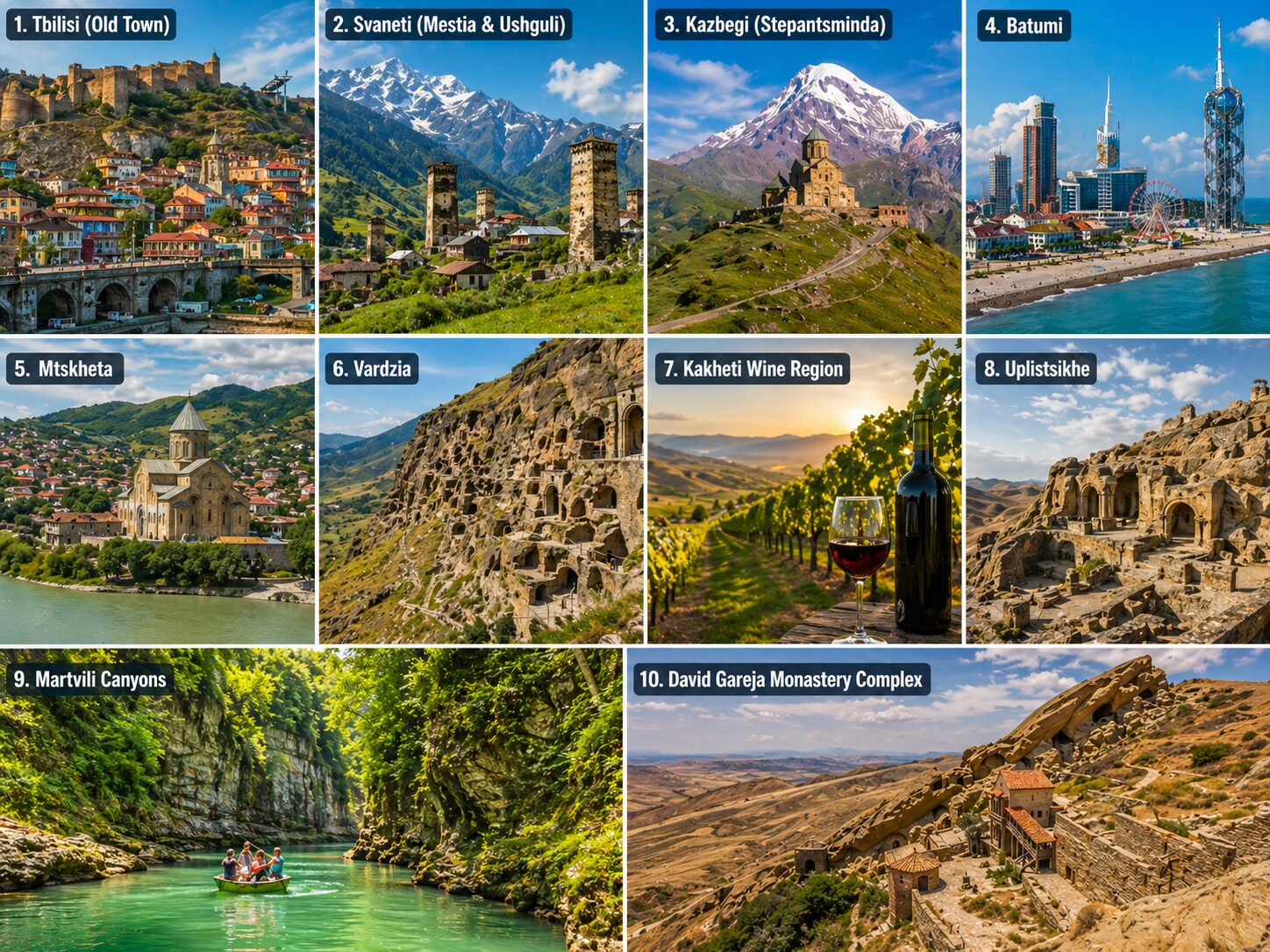
1. Tbilisi
Why visit: Historic capital with Old Town, sulphur baths, churches and modern neighbourhoods. It’s one of the top places to visit in Georgia.
Things to do:
- Explore Old Tbilisi
- Visit Narikala Fortress
- See the Bridge of Peace
- Visit the sulphur baths
- Walk along Rustaveli Avenue
Recommended stay: 2–3 days
Best for: First-time visitors, history, food and nightlife.
2. Kazbegi
Why visit: Spectacular mountain scenery, Gergeti Trinity Church, hiking, and authentic highland villages.
Things to do:
- Hike or drive to Gergeti Trinity Church
- Explore Stepantsminda village
- Visit Dariali Gorge
- Trek to Gveleti Waterfalls
- Enjoy views of Mount Kazbek
Recommended stay: 2 days
Best for: Nature lovers, hikers, photographers, adventure seekers.
3. Batumi
Why visit: Black Sea resort city with beaches, vibrant nightlife, modern architecture, and lush gardens.
Things to do:
- Stroll Batumi Boulevard
- Visit the Botanical Garden
- See the Alphabet Tower
- Relax on the beach
- Explore Europe Square and the Old Town
Recommended stay: 2–3 days
Best for: Beach holidays, nightlife, families, summer festivals.
4. Kakheti
Why visit: Georgia’s famous wine region, historic monasteries, and charming hill towns.
Things to do:
- Wine tasting in Telavi or Sighnaghi
- Tour local vineyards and qvevri cellars
- Visit Alaverdi Monastery
- Explore Sighnaghi’s walled town
- See Tsinandali Estate
Recommended stay: 2–3 days
Best for: Wine lovers, foodies, culture enthusiasts, couples.
5. Mtskheta
Why visit: Ancient spiritual capital, UNESCO World Heritage churches, and scenic river views.
Things to do:
- Visit Svetitskhoveli Cathedral
- Explore Jvari Monastery
- Walk the old town streets
- Enjoy riverside cafes
Recommended stay: Half-day to 1 day (easy day trip from Tbilisi)
Best for: History buffs, culture seekers, photographers.
6. Kutaisi
Why visit: One of Georgia’s oldest cities, rich in history, culture, and natural wonders.
Things to do:
- Visit Bagrati Cathedral and Gelati Monastery (UNESCO)
- Explore Sataplia and Prometheus Caves
- Stroll through Kutaisi’s central market
- Walk along the Rioni River
Recommended stay: 1–2 days
Best for: Families, history lovers, nature explorers.
7. Gudauri
Why visit: Premier ski and adventure resort in the Caucasus, with breathtaking mountain views.
Things to do:
- Ski or snowboard in winter
- Try paragliding or snowmobiling
- Visit the Russia–Georgia Friendship Monument
- Take scenic mountain drives
Recommended stay: 2–3 days (longer in ski season)
Best for: Skiers, snowboarders, adventure travelers, mountain lovers.
8. Sighnaghi
Why visit: Romantic hilltop town with stunning views, wine culture, and cobbled streets.
Things to do:
- Walk the city walls for panoramic views
- Tour local wine cellars
- Visit Bodbe Monastery
- Explore art galleries and cafes
Recommended stay: 1–2 days
Best for: Couples, wine & food lovers, photographers.
9. Borjomi
Why visit: Famous for its mineral waters, health resorts, and nearby forests and mountains.
Things to do:
- Stroll Borjomi Central Park
- Taste mineral water at the spring
- Hike in Borjomi-Kharagauli National Park
- Visit Romanov Palace
Recommended stay: 1–2 days
Best for: Wellness escapes, nature lovers, families.
10. Vardzia
Why visit: Impressive cave monastery complex carved into a cliffside, with rich medieval history.
Things to do:
- Tour the cave tunnels and chapels
- See ancient frescoes
- Visit nearby Khertvisi Fortress
- Hike the surrounding countryside
Recommended stay: Half-day to 1 day
Best for: History enthusiasts, culture fans, adventurous travelers.
Traditional Georgian Food You Must Try
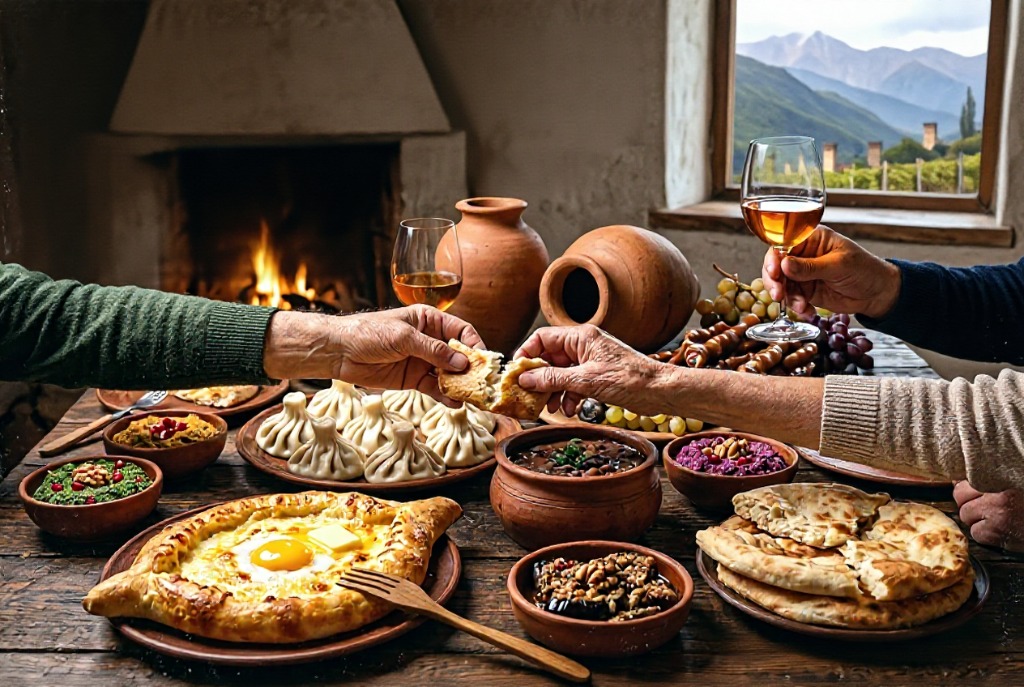
Khachapuri
- What it is: Georgia’s national dish—cheese-filled bread, soft inside with a golden crust.
- Where it comes from: Found everywhere in Georgia, with regional variations. The most famous, Adjarian khachapuri, is boat-shaped and topped with a runny egg and butter.
- Which version to try: Try Adjarian (Acharuli) khachapuri in Batumi or Tbilisi bakeries, or Imeretian (round, stuffed with cheese) for a classic taste.
Khinkali
- What it is: Large, juicy dumplings filled with spiced meat (or sometimes mushrooms/potatoes in mountain regions).
- How to eat it: Hold the top knot, bite to sip the broth, then eat the rest—leave the doughy stem on your plate.
- Where to find it: Ubiquitous in Tbilisi taverns, roadside cafes, and especially in mountain regions like Kazbegi.
Mtsvadi
- What it is: Georgian grilled meat skewers—usually pork, beef, or lamb—cooked over wood or charcoal.
- Why it’s popular: Served at every supra (feast), mtsvadi is prized for its smoky flavour and simplicity.
- Where to try: Best enjoyed at countryside restaurants or family-run guesthouses, especially in Kakheti or at open-air markets.
Lobio
- What it is: Hearty bean stew, slow-cooked with onions, herbs, and spices—often served with mchadi (cornbread).
- Where to try: Found in Tbilisi’s traditional restaurants and rural taverns; every family has its own recipe.
Chakhokhbili
- What it is: A warming chicken stew simmered with tomatoes, onions, fresh herbs, and a hint of tarragon.
- Where to try: Popular across Georgia—look for it in homestyle cafes or order it during a family meal in Kakheti.
Badrijani Nigvzit
- What it is: Thin slices of fried eggplant rolled with a walnut-garlic paste and topped with pomegranate seeds.
- Where to try: Served as a starter at almost every Georgian feast and available in most traditional restaurants.
Churchkhela
- What it is: Georgian “candy”—strings of walnuts (or hazelnuts) repeatedly dipped in thickened grape juice, then hung to dry.
- Where to try: Sold at markets, roadside stalls, and souvenir shops across Georgia—especially during grape harvest season.
Pkhali
- What it is: Cold vegetable pâté (often made with spinach, beets, or eggplant) mixed with ground walnuts, garlic, and herbs.
- Where to try: Served as a colourful starter at supras, in Tbilisi restaurants, and in rural guesthouses; always topped with pomegranate seeds for a finishing touch.
Dining Tip: Eat in local bakeries and markets for the best (and cheapest) flavors. Don’t miss a traditional supra—Georgian foods are legendary for a reason!
Also Read: 20 Most Romantic Places in the World
Travel Costs for Georgia Country
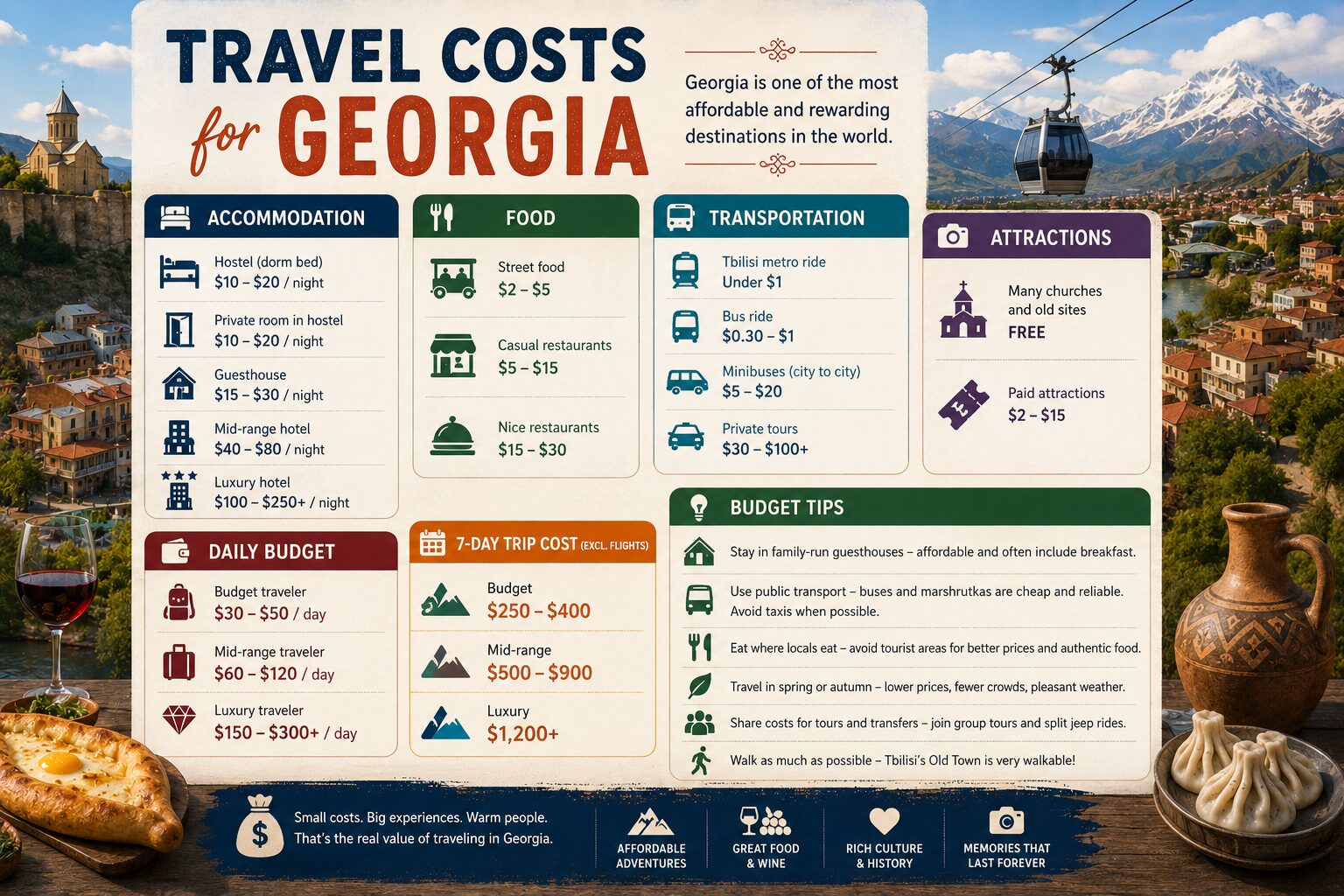
Georgia Travel Cost
| Expense | Budget | Mid-range | Luxury |
|---|---|---|---|
| Accommodation/night | $10–30 | $40–80 | $100+ |
| Food/day | $10–20 | $25–50 | $60+ |
| Transportation/day | $5–15 | $15–30 | $50+ |
| Activities/day | $0–20 | $20–50 | $50+ |
These estimates exclude international flights and can vary depending on season, exchange rates, accommodation and activities.
What’s Included and What’s Not
Included:
- Accommodation (hostel dorm, guesthouse, hotel)
- 2–3 meals per day
- Local transport (marshrutka, bus, taxi, or car rental)
- Typical sightseeing and some paid attractions
Not included:
- International flights
- Travel insurance
- Souvenirs and shopping
- Nightlife, spa treatments, or private tours
Regional Price Differences
- Tbilisi and Batumi: More expensive for accommodation and dining; wider range of options.
- Mountain areas (Kazbegi, Svaneti): Slightly higher food/transport costs due to remoteness, but guesthouses often include meals.
- Rural regions: Cheapest for lodging and local food; cash is essential.
Seasonal Price Variations
- Peak (Summer, Wine Harvest): Accommodation and tours are most expensive June–August and September–October.
- Shoulder (Spring, Autumn): Best balance of price and weather.
- Winter: Ski resorts (Gudauri, Bakuriani) are pricier, but cities and wine regions are affordable.
Hidden & Extra Costs to Consider
- ATM withdrawal fees (check with your bank)
- SIM cards/mobile data ($2–$10 for a week)
- Entry fees for museums, monasteries, and UNESCO sites ($2–$10 each)
- Occasional tips for guides or drivers (not mandatory but appreciated)
- Car rental insurance or petrol (if self-driving)
Example Daily Budgets
- Budget Traveler: $30–$50/day
Hostel dorm, local food, marshrutka transport, free/cheap sights. - Mid-Range Traveler: $60–$120/day
Private guesthouse or boutique hotel, a mix of local and restaurant meals, taxis or car rental for day trips, some tours. - Luxury Traveler: $150–$300+/day
High-end hotels, fine dining, private guides, spa treatments, and personalized experiences.
Payment Methods & Currency Tips
- Cash is essential outside major cities; many rural guesthouses and markets do not accept cards.
- ATMs are widely available in Tbilisi, Batumi, and Kutaisi; some charge fees for foreign cards.
- Exchange rates are best at banks or ATMs, not airport kiosks.
- Always carry small bills for marshrutkas, tips, and markets.
Budget Tips:
- Staying in homes run by families often means lower prices. Meals in the morning are part of the deal most times. Big brand extras get left out here; simplicity wins instead. Small kindnesses show up when you talk with hosts each day. Every morning kicks off with food right where you are, part of the deal. Prices hold steady, low but never skimping on ease.
- Buses run often, yet marshrutkas move more quickly between stops. One saves money, while the other cuts down travel time. Taxis cost more, so skipping them makes sense. Riding together with others lowers traffic slowly. Fewer private rides mean less congestion overall.
- Most times, eating where locals eat beats spots near tourist zones. Hidden corners of town dish out flavor without draining wallets. Good food hides in plain sight, just past the busy streets. Value sneaks into meals when you skip the obvious stops. Real taste waits where maps rarely point.
- Spring trips often cost less. The weather turns mild then. Autumn brings fewer crowds. Cooler days show up. Prices drop during these months. Skies stay clearer much of the time. Crowds shrink outside the summer rush. Warmth lingers in early autumn. Flowers bloom by late spring. Shoulder seasons skip the extremes. Cold fades before it returns.
- Most folks chip in when they ride jeeps together through rough trails. Splitting the tab happens more easily if a few show up for wine spots, too. Everyone gives smaller amounts since the numbers spread what’s owed. Riding along with others cuts down on how much cash changes hands. Stuff like shuttles and gate passes? Those usually come bundled when names get added to one list. Sharing costs turns big trips into something everyone can handle. When each person pays their part, it works out better all around.
- Walk as much as possible. Tbilisi’s Old Town is very walkable.
Affordable Travel in Georgia: 7-Day Georgia Itinerary
Day 1: Explore Tbilisi
Begin your journey in Georgia’s vibrant capital. Tbilisi’s compact Old Town is best explored on foot—cobblestone streets, hidden cafes, and historic sites like Freedom Square, the Bridge of Peace, and Narikala Fortress are all within walking distance. For the evening, enjoy local restaurants and street life in Old Tbilisi.
Getting around: Walking is ideal, but taxis and the Tbilisi metro are both cheap and widely available (download the Bolt app for reliable taxi service).
Day 2: Tbilisi
Visit the impressive Holy Trinity Cathedral, unwind in the iconic sulphur baths, stroll Rustaveli Avenue (Tbilisi’s main boulevard), and take the funicular up to Mtatsminda Park for panoramic city views.
Getting around: Use the metro or a taxi for longer distances. The funicular to Mtatsminda departs from central Tbilisi.
🇬🇪 Travel Smarter – Speak Georgian!
Don’t let the language barrier hold you back. This complete Georgian beginner course teaches you how to introduce yourself, order food, and get directions – perfect for your 7-day adventure.
Start Learning Georgian Today 👇

Day 3: Tbilisi to Kazbegi (Stepantsminda)
Start early and travel north along the spectacular Georgian Military Highway. Stop at the lakeside Ananuri Fortress and enjoy a mountain break in Gudauri before reaching Stepantsminda/Kazbegi.
Transportation:
- Marshrutka (minibus): The most popular and affordable option; departs from Didube bus station in Tbilisi (about 3–4 hours, $5–$7).
- Private car/taxi: More flexible—good for groups or those wanting to stop en route for photos (expect to pay $60–$100 for a full-day hire).
- Tours: Many guesthouses and tour operators offer day trips or transfers with sightseeing stops.
Day 4: Kazbegi
Marvel at the iconic Gergeti Trinity Church, perched above Stepantsminda with stunning views of Mount Kazbek. Adventurous travellers can hike or take a 4×4 up to the church. Extend your day with a trip to Juta Valley or other mountain excursions.
Getting around:
- Walking: For those up for a hike (approx. 1.5–2 hours uphill).
- 4×4 taxis: Readily available in town; share with other travellers to save costs (about $20–$30 per vehicle for the round trip).
Day 5: Kakheti (Wine Region)
Head east to Kakheti, Georgia’s legendary wine region. Visit Sighnaghi (“City of Love”), enjoy wine tastings, and sample local cuisine.
Transportation:
- Marshrutka: Regular minibuses from Tbilisi’s Samgori or Isani stations to Sighnaghi (2–3 hours, $4–$6).
- Car rental: Recommended for flexibility, especially if you want to visit multiple wineries or rural villages.
- Group tours: Many Tbilisi-based companies offer day tours with tastings and meals included.
Day 6: Return/Continue Toward Batumi
Depending on your time, you can return to Tbilisi for a day of rest or continue directly west toward Batumi on the Black Sea coast.
Transportation:
- Train: Modern, comfortable trains connect Tbilisi and Batumi (5–6 hours, $10–$15, book in advance during peak season).
- Marshrutka: Frequent minibuses, slightly faster but less comfortable.
- Car rental: Allows for stops in Kutaisi or other towns along the way.
Day 7: Batumi
Discover Batumi’s seaside charms: stroll Batumi Boulevard, visit the romantic Ali & Nino statue, admire the Alphabet Tower, and relax in the sprawling Botanical Garden.
Getting around:
- Walking/Bike rental: The seafront and main attractions are walkable; rental bikes are popular for exploring the boulevard.
- Taxis: Affordable and easy to find, especially for reaching the Botanical Garden (about 10–15 minutes from the city centre).
Departure:
Batumi has an international airport with flights to Europe, Turkey, and elsewhere. Alternatively, return to Tbilisi by train, bus, or car.

How Many Days Do You Need in Georgia?
- 3–4 days: Enough for Tbilisi and one day trip (such as Mtskheta or Kakheti).
- 5–7 days: Explore Tbilisi, Kazbegi (Stepantsminda), and one additional region like Kakheti or Gudauri.
- 8–10 days: See Tbilisi, venture into the mountains (Kazbegi or Svaneti), tour Kakheti’s wine country, and relax on the Black Sea in Batumi.
- 10–14 days: Experience a comprehensive trip, covering Tbilisi, multiple mountain regions, the wine route, Batumi, and off-the-beaten-path gems like Vardzia, Borjomi, or Sighnaghi.
Georgia Visa and Entry Requirements
Who Needs a Visa:
Georgia offers one of the most liberal entry policies in the region. Citizens of over 90 countries—including the EU, UK, USA, Canada, Australia, New Zealand, Japan, South Korea, most Gulf countries, and many others—can enter Georgia visa-free for up to one year for tourism, business, or family visits.
Fact: India, China, and many African and Central Asian passport holders must apply for a visa in advance or may be eligible for an e-visa.
Visa-Free Entry (Where Applicable):
If you hold a passport from a visa-exempt country, you do not need a visa for short visits (up to 365 days). Residents with valid visas or residence permits from the EU, UK, USA, Canada, Australia, New Zealand, Japan, South Korea, and certain Gulf countries can also enter Georgia visa-free for up to 90 days within a 180-day period.
Passport Validity:
Your passport must be valid for at least six months beyond your planned entry date. Ensure your passport has at least one blank page for entry stamps.
Entry Requirements:
- Proof of onward travel or return ticket (rarely checked, but advisable)
- Proof of sufficient funds for your stay (sometimes checked)
- Accommodation details (hotel booking, invitation, or address of stay)
- Health or travel insurance is not mandatory but strongly recommended
Where to Verify Current Requirements:
Visa and entry rules can change. Always check the latest information before you travel:
- Official Georgian Government Consular Portal
- Ministry of Foreign Affairs of Georgia
- Your nearest Georgian embassy or consulate
Best Time to Visit Georgia
| Season | Months | Best For |
|---|---|---|
| Spring | Apr–May | Cities, nature, mild weather |
| Summer | Jun–Aug | Mountains, Batumi |
| Autumn | Sep–Oct | Wine region, sightseeing |
| Winter | Dec–Feb | Skiing, snow |
April kicks things off with gentle warmth, greenery wakes up, and sunlight lingers. Travelers show up when paths dry out, breezes soften. By June, summer settles in, stretching into August. Batumi basks, sea temperatures rise, and people dip daily. Up above, mountain trails cut across bright slopes, favored by steady walkers. Skies hold still, offering clean sightlines far ahead.
Out comes the sun over Tbilisi now and again. As autumn settles between September and October, grapevines swell across Kakheti, and golden hours follow once picking begins. A hush arrives with crisper winds, yet scenery pulls you into longer glances. When winter grips from December onward, eyes turn uphill where Gudauri wakes beneath heavy snow. Peaks stay blanketed, even as frost nips mornings in the city far below.
The best overall times to visit Georgia are from May to June and from September to October.
Travel Tips for Georgia
- Carrying cash makes things easier when you head out to rural areas; digital payments are hard to find there.
- Warmth shows up in tiny ways, like saying hello in a new tongue. A clumsy phrase, offered gently, lands better than perfect speech. Doors crack open through attempts, not mastery. Kindness weighs more than correct sounds. People notice trying, even when words stumble.
- Most holy spots ask for clothes that cover arms down to wrists, legs down to ankles. When entering sacred spaces, longer tops and floor-length outfits are standard. Fabric needs to drape over shoulders, flow past knees, tiny rules with quiet weight. Tourists might miss these points, but they color how guests are seen. A detail brushed aside may shift warmth in welcome.
- A traveler could grab a regional SIM card just moments after arriving, then enjoy cheaper data and calling almost immediately. Because of this, staying online feels easier, cutting out global roaming fees. Once slotted into the phone, costs dip fast. Signals show up on screen before long, usually in under ten minutes. Strong reception pops up across urban spots, occasionally even farther out.
- Try traditional Georgian cuisine for sure.
- Book accommodation in advance during the summer and the wine harvest season.
Frequently Asked Questions About Georgia Travel
Do we need visa for Georgia?
If you hold an Indian passport, you need a visa for Georgia unless you hold a valid visa or residence permit from the US, the UK, the Schengen area, Canada, Australia, Japan, or the GCC countries.
How much money is it allowed to bring to Georgia?
There is no maximum cash limit for bringing money into Georgia, but you must complete a customs declaration form if you carry more than 30,000 Georgian Lari (GEL) or its equivalent in foreign currency.
Which is cheaper, Bali or Georgia?
Georgia is generally slightly cheaper than popular tourist areas in Bali, though overall costs depend heavily on your specific lifestyle and location.
How much does a 7 day trip to Georgia cost?
A 7-day trip to the country of Georgia typically costs between $600 and $1,500 USD per person (or roughly ₹65,000 to ₹1,20,000 if traveling from India), including flights, local travel, food, and mid-range stays.
What is the most famous food in Georgia?
The most famous food in the country of Georgia is Khachapuri, a traditional cheese-filled bread.
Is Georgia good for first-time travellers?
Yes, the country of Georgia is an excellent destination for first-time travellers because it offers a mix of rich history, stunning mountain landscapes, and affordable prices.
What to wear as a tourist in Georgia?
As a tourist in Georgia, you should wear versatile layers and modest clothing that respects local religious traditions, especially when visiting churches.
Conclusion
Deep in the Caucasus, Georgia draws notice not with noise but quiet presence. Down Tbilisi’s old stone paths, age-old churches stand close to walls bursting with bright painted stories. Heading toward Kazbegi, the route climbs narrow passes where white mountain summits loom overhead. By the coast, Batumi moves at a hush, salt mist hanging heavy in the breeze. Inland from tides, rows of vines snake across Kakheti like echoes buried deep in soil.
Out here, good value sits beside filling food, matched by smiles that feel like home. Past the streets, land shifts, waves give way to hills, followed by lines of vines beneath wide horizons. Not many come expecting a lot; yet nearly everyone walks away stunned at how things turned out after crossing the threshold.
Enjoyed the article, follow dturban for more fashion/lifestyle updates.