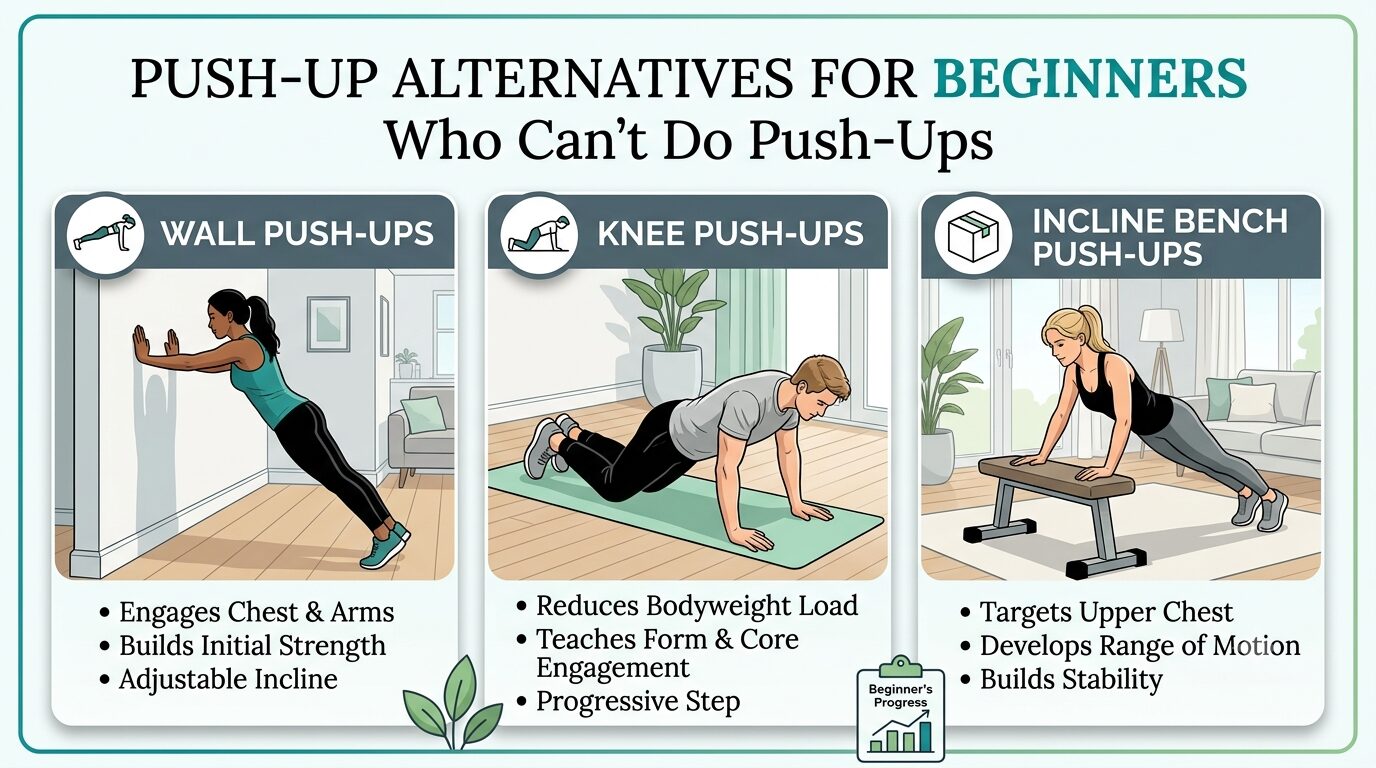
Push-Up Alternatives for Beginners Who Can’t Do Push-Ups
- Nikhil Rana
- June 30, 2026
- Health
- Push-Up Alternatives for Beginners
- 0 Comments
Push-ups are often seen as a basic test of strength, but for many beginners, they’re anything but easy. If you struggle to do even one full push-up, you’re not alone! The good news? You can build strength, confidence, and muscle with push-up alternatives that are beginner-friendly, safe, and effective—no gym required.
This guide is designed to meet you where you are. We’ll cover the best push-up modifications, explain how to progress safely, and share expert advice and real-life experience to help you get stronger at home.
“Push-up alternatives are the perfect way to build upper body strength without sacrificing form or risking injury. Every small step counts.”
— Jenna Hill, CPT, ACE-certified trainer
— Jenna Hill, CPT, ACE-certified trainer
Why Can’t Some Beginners Do Push-Ups (Yet)?
Push-ups require not just arm strength, but core stability, chest power, and shoulder control. Many beginners lack the strength or form—often due to sedentary lifestyles or lack of previous training.
Fact: A Harvard Health review notes that even active adults can initially struggle with push-ups due to poor posture or weak core muscles.
Best Push-Up Alternatives for Beginners
Each move below is safe, effective, and easy to do at home—no equipment necessary.
1. Wall Push-Ups
- How to: Stand facing a wall, arms extended. Lower your chest to the wall, keeping your body straight, then push back.
- Why it works: Reduces the resistance, making it perfect for absolute beginners.
2. Incline Push-Ups
- How to: Place your hands on a stable surface (table, countertop, or sofa), feet on the floor. Lower your chest toward the surface, then push up.
- Why it works: Lessens the load on your arms and core, allowing you to focus on form.
- Tip: The higher the surface, the easier the move. Lower it as you get stronger.
3. Knee Push-Ups
- How to: Start in a plank position but drop your knees to the ground. Keep your body straight from head to knees. Lower your chest to the floor, then press up.
- Why it works: Takes some weight off your arms and chest, but still engages your upper body and core.
- Expert quote: “Knee push-ups are a legitimate exercise. Don’t let anyone call them ‘girl push-ups’—they’re for everyone learning proper form.” — ACE Fitness
4. Negative (Eccentric) Push-Ups
- How to: Start at the top of a push-up (on toes or knees). Lower yourself as slowly as possible to the ground. Use knees or hands to help push back up.
- Why it works: Eccentric (lowering) strength often develops before concentric (pushing up) strength. This move helps bridge the gap.
- Editorial: “Negatives taught me control and helped me break through a serious plateau.”
5. Chest Press With Resistance Bands
- How to: Anchor a band behind you (door, heavy furniture), hold the handles, and press forward like a push-up.
- Why it works: Mimics the push-up movement without requiring you to lift your full body weight.
- Tip: Great for those who want to add resistance gradually.
6. Plank Holds
- How to: Hold a plank on your hands or forearms, keeping your body straight.
- Why it works: Builds the core and shoulder stability needed for full push-ups.
- Expert insight: “Most people struggle with push-ups because their core isn’t strong enough—planking fixes that.” — Mayo Clinic
7. Standing Chest Squeeze
- How to: Stand straight, arms at chest height, palms together. Press hands together as hard as you can, hold for 5–10 seconds, release.
- Why it works: Activates chest, shoulders, and arms safely.
Also Read: Full Body Workout at Home Without Equipment
How to Progress to Full Push-Ups
- Start with wall push-ups; aim for 3 sets of 10–15 reps.
- Move to incline push-ups as you get stronger.
- Practice knee push-ups and negatives; focus on slow lowering.
- Finish with planks to build core strength.
- Test a full push-up weekly—one rep with perfect form is better than five sloppy ones.
“Building strength is a journey. Celebrate every step—even if it’s just holding a plank 10 seconds longer.”
— Chris Jordan, exercise physiologist
— Chris Jordan, exercise physiologist
FAQs: Push-Up Alternatives for Beginners
Can I build muscle with push-up alternatives?
Absolutely. These moves target the same muscles and build a solid foundation.
Absolutely. These moves target the same muscles and build a solid foundation.
How often should I train push-up progressions?
2–3 times per week, with rest days between.
2–3 times per week, with rest days between.
What if I have wrist pain?
Try fist push-ups, use push-up handles, or do standing chest squeezes instead.
Try fist push-ups, use push-up handles, or do standing chest squeezes instead.
How do I know if I’m doing it right?
Record yourself or check form in a mirror. Your body should form a straight line, and your elbows shouldn’t flare too wide.
Record yourself or check form in a mirror. Your body should form a straight line, and your elbows shouldn’t flare too wide.
Where can I find video demonstrations?
Try FitnessBlender’s Push-Up Progression Video or HASfit’s Beginner Push-Up Alternatives.
Try FitnessBlender’s Push-Up Progression Video or HASfit’s Beginner Push-Up Alternatives.
Related Articles:
Conclusion
If push-ups feel impossible now, don’t stress. With these push-up alternatives, you’ll build real strength, confidence, and progress safely—no matter your starting point. It’s never about perfection; it’s about progress and giving yourself credit for every rep and every step forward.
“Every strength journey starts with a single push-up—or a wall push-up. Keep at it, and your body will surprise you.”
— Jenna Hill, CPT
— Jenna Hill, CPT