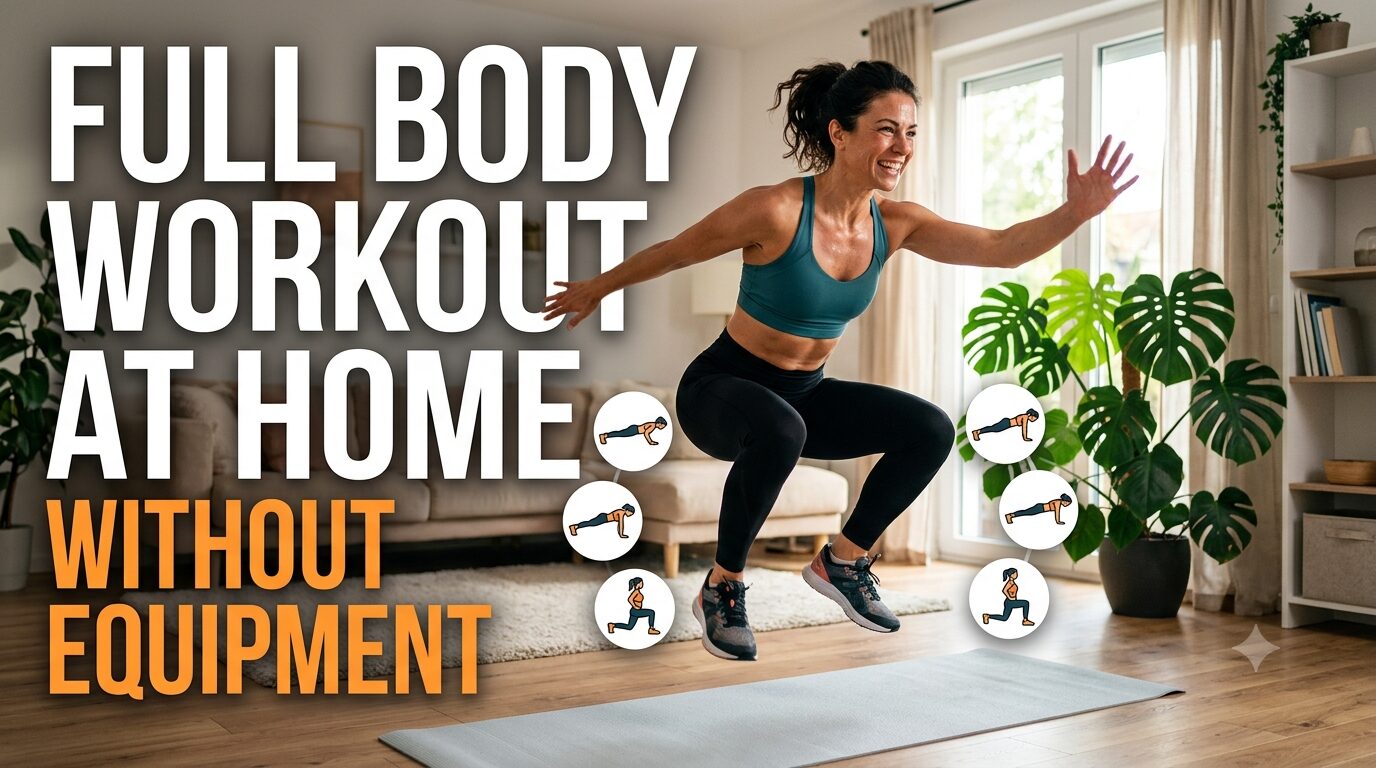
Full Body Workout at Home Without Equipment
- Nikhil Rana
- June 30, 2026
- Health
- Full Body Workout at Home Without Equipment
- 0 Comments
You don’t need a gym membership or expensive gear to get strong, fit, and healthy. A carefully designed full body workout at home without equipment can challenge every muscle, boost your energy, and deliver real results—no matter your space, schedule, or starting point. This guide is built from expert advice, science-backed routines, and real experience from people who have transformed their fitness with nothing but commitment and bodyweight moves.
Why Do a Full Body Workout at Home Without Equipment?
- Accessibility: No more waiting for machines or worrying about gym hours.
- Affordability: Bodyweight training is completely free.
- Time Efficient: No commute—just roll out of bed and start moving.
- Adaptability: Perfect for all fitness levels, ages, and body types.
“A full body workout at home without equipment is one of the most effective ways to build strength, burn fat, and improve flexibility at any age.” — Jenna Hill, CPT, ACE-certified trainer
What Makes a True Full Body Workout?
A proper full body morning workout routine hits all major muscle groups:
- Chest, back, shoulders, arms
- Core (abs, lower back, obliques)
- Legs (quads, glutes, hamstrings, calves)
The best routines alternate push and pull movements, combine strength and cardio exercises at home, and include both static and dynamic exercises.
Sample Full Body Workout at Home Without Equipment
This routine takes about 30 minutes. All you need is your body, a little floor space, and motivation.
Warm-up (5 minutes):
- 30 seconds jumping jacks
- 30 seconds arm circles
- 30 seconds high knees
- 30 seconds bodyweight squats
- 1 minute alternating lunges
- 2 minutes dynamic stretching (toe touches, hip circles, etc.)
Main Circuit (Repeat 2–3x):
- Push-ups (any variation: knee, incline, or full)
Reps: 10–15
Targets: Chest, triceps, shoulders, core
Editorial: “Start on your knees if needed—proper form beats higher reps.” - Bodyweight Squats
Reps: 15–20
Targets: Quads, glutes, hamstrings
Fact: Studies show squats improve lower body strength and balance. - Glute Bridges
Reps: 15
Targets: Glutes, lower back, hamstrings
Tip: Squeeze at the top for max effect. - Plank
Time: 30–60 seconds
Targets: Core, shoulders
Editorial: “Don’t worry if you shake; that’s your muscles getting stronger.” - Superman
Reps: 12
Targets: Lower back, glutes, shoulders - Reverse Lunges
Reps: 10–12 each leg
Targets: Glutes, hamstrings, quads - Triceps Dips (using a chair or low table)
Reps: 10–15
Targets: Triceps, shoulders - Mountain Climbers
Time: 30 seconds
Targets: Cardio, core, shoulders
Cool Down (5 minutes):
Child’s pose, hamstring stretch, quad stretch, shoulder/arm stretch
Child’s pose, hamstring stretch, quad stretch, shoulder/arm stretch
How to Progress Your Home Workouts
- Increase reps/sets: Add more rounds or reps as you get stronger.
- Slow down the movement: Increases time under tension for muscle growth.
- Try harder variations: Single-leg squats, decline push-ups, side planks.
- Shorten rest: Less rest = higher intensity.
Who Is This For?
- Beginners: All moves can be modified—start with knee push-ups, shallow squats, or wall planks.
- Intermediate/Advanced: Increase rounds, add plyometrics (jump squats, burpees), or slow tempo for a challenge.
- Anyone in limited space: You can do this routine in a living room, dorm, or even outdoors.
“I started my fitness journey with home bodyweight workouts after my first baby. In 3 months, I felt stronger, slept better, and had more energy to play with my kids. You don’t need fancy equipment—just a good routine and a little consistency.”
— Priya S., New Delhi
— Priya S., New Delhi
- Bodyweight training improves muscular endurance and functional strength, according to ACE Fitness.
- A Harvard Medical School review confirms that regular bodyweight exercises reduce heart disease and improve mental health.
- “Form matters most—quality reps beat quantity every time.” — Chris Jordan, exercise physiologist
How Often Should You Do a Full Body Home Workout?
- Beginners: 2–3 times per week with a rest day between.
- Intermediate/Advanced: 3–5 times per week, mixing intensity and rest.
Common Mistakes to Avoid
- Skipping warm-ups or cool-downs
- Not focusing on form
- Doing too much too soon
- Overlooking recovery and sleep
- Getting bored—switch up your routine!
Staying Motivated at Home
- Set a schedule and treat it like an appointment.
- Track your progress in a notebook or app.
- Find a virtual workout buddy or join online communities.
- Celebrate small wins: more reps, less rest, or just showing up!
FAQs: Full Body Workout at Home Without Equipment
Q: Can I build muscle without equipment?
A: Yes! Progressive overload (more reps, harder variations) builds muscle with just bodyweight.
A: Yes! Progressive overload (more reps, harder variations) builds muscle with just bodyweight.
Q: Is this safe for beginners?
A: Absolutely—start with easier modifications and focus on form.
A: Absolutely—start with easier modifications and focus on form.
Q: How can I make it harder?
A: Add a backpack for resistance, try single-leg moves, or reduce rest.
A: Add a backpack for resistance, try single-leg moves, or reduce rest.
Q: What if I have joint pain?
A: Swap high-impact moves for gentler options, or consult a physiotherapist.
A: Swap high-impact moves for gentler options, or consult a physiotherapist.
Q: Where can I find video guides?
A: Try FitnessBlender, HASfit, or certified trainer YouTube channels for demonstrations.
A: Try FitnessBlender, HASfit, or certified trainer YouTube channels for demonstrations.
Related Articles:
- Push-Up Alternatives for Beginners Who Can’t Do Push-Ups
- 3 Best Exercises to Lose Belly Fat After 60 Safely and Effectively
- Best Yoga Poses for Belly Fat Reduction
Final Thoughts
A full body workout at home without equipment is proof that fitness is for everyone, everywhere. The magic isn’t in the gear—it’s in the commitment to show up, move, and improve a little each day. Whether you’re just starting or looking to level up, this guide gives you the tools, encouragement, and structure to succeed.
“You don’t need perfection, you just need to begin. Your body will thank you—and so will your mind.”
— Jenna Hill, CPT
— Jenna Hill, CPT